

Projects & Research
Below are some examples of past student projects. All these were done outside normal coursework. If you are interested in doing a research project, talk to our faculty. There are several structured ways to do research at Butler, including the Butler Summer Institute and the Math Research Camp run by the Mathematical Sciences department. Occasionally, some of our faculty have access to research funding and can partially support a student or two. You can present the results of your work at Butler’s Undergraduate Research Conference.
Tango: A New Programming Language

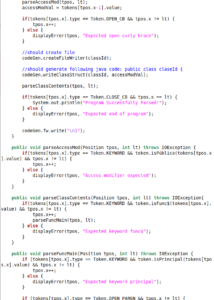
Ashley Zegiestowski (2016) double-majored in Spanish and computer science. While at Butler, she spent a semester abroad in Argentina. For her honors thesis, “Tango: A Spanish-Based Programming Language,” she created her own, new, programming language that utilized Spanish keywords. She specified Tango’s grammar and then wrote a cross-compiler, based on a recursive-descent parser, so she could run Tango programs. Her thesis includes a guessing-game program written in Tango.
GuideDawg Mobile App Project
This app is like a “Google maps” for those who are visually impaired. The app using GPS on a smartphone, connects to a database of known landmarks within a building or on a small campus area, and gives audio signals when designated landmarks are near. An administrator can manage routes and landmarks through a web interface. The app was originally designed for use by the students at the Indiana School for the Blind and Visually Impaired.
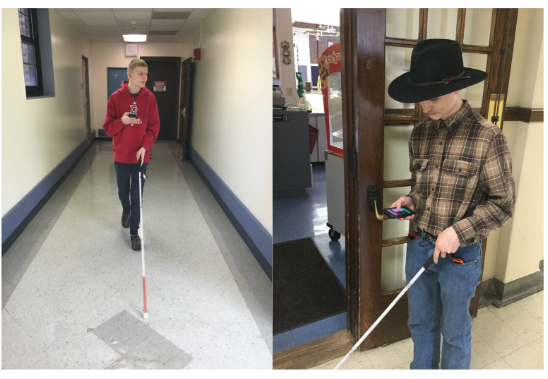
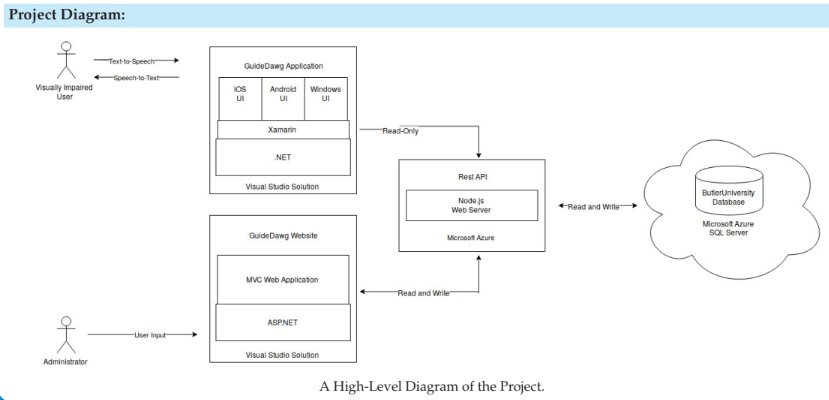
Some of the tech used included Visual Studio, Xamarin, Microsoft Azure, SQL Server, ASP.NET MVC, Node.js/javascript, WordPress, and XCode (swift).
This project was supported by a Butler Innovation Fund grant awarded to Prof. Panos Linos, the faculty supervisor for the project, which spanned several years. Students who worked on the project include Jacob Scheib, Devin Edmundowicz, Brandon Weber, Adam Kessler, Rachel Burke, Ryan Graham, David Purdom, and Gabriella Forsythe. Nate Partenheimer also consulted on the project.
A Textbook for Texas

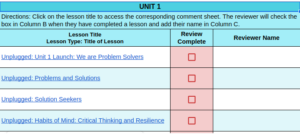
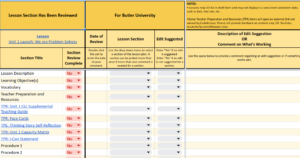
In January of 2023, Ellipsis Education (then known as Codelicious) was pulling together a digital textbook for teaching computer science to elementary and middle school students. In order to obtain state certification for Texas, their materials needed vetting by qualified computer scientists. However, the volume of material made it impractical to hire faculty or similar professionals to review everything. The CEO of Ellipsis Education, Whitney Dove, reached out to us for help. Under the supervision of Prof. Jon Sorenson, 23 Butler upper-division computer science and software engineering students read, reviewed, and commented on roughly 450 lessons, each including lesson plans, background material, and activities.
Computer Science Meets Psychology
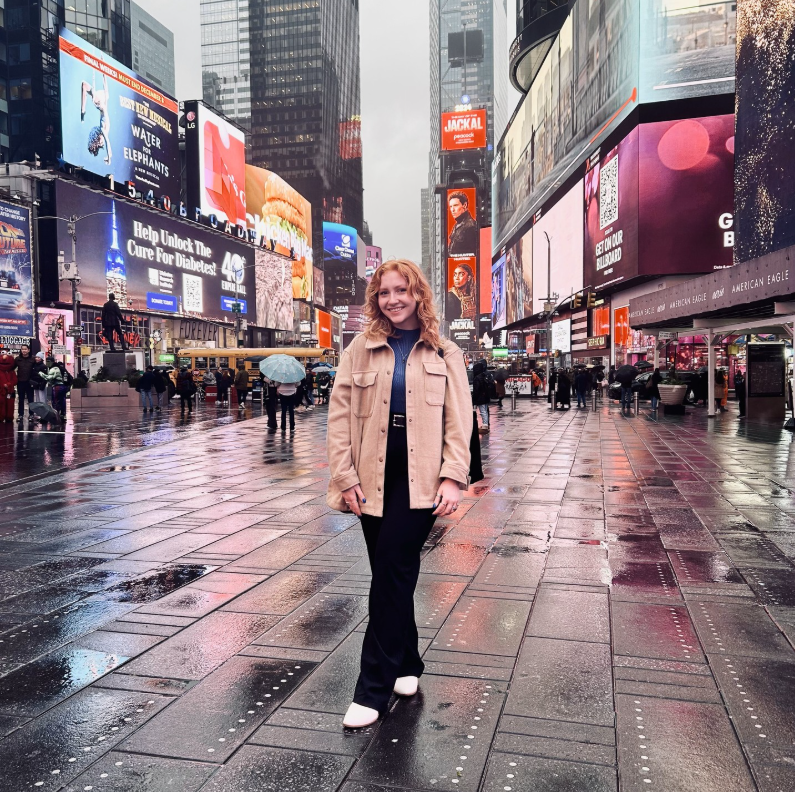
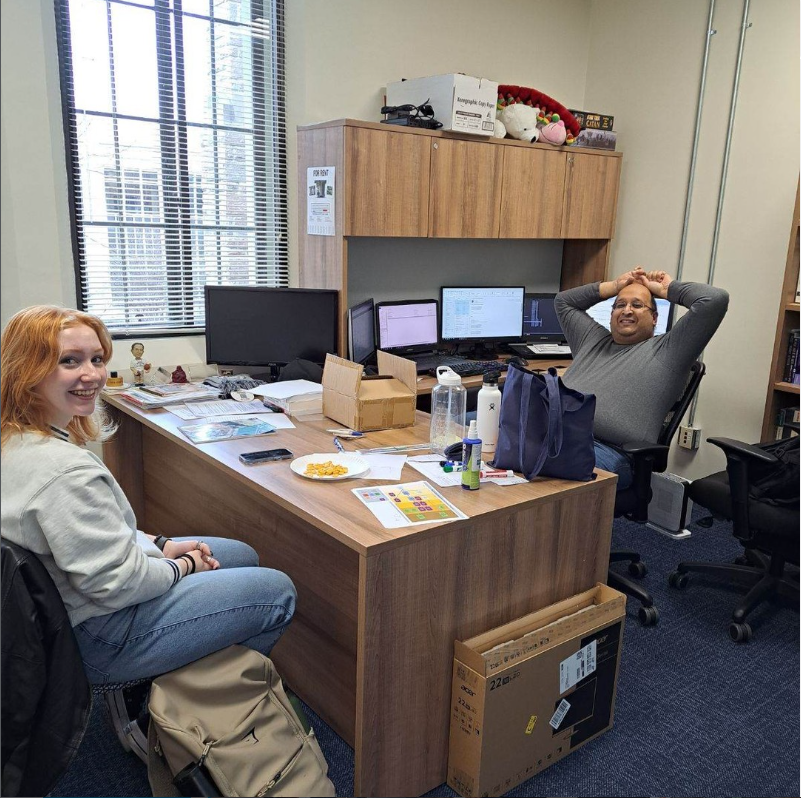
Abi Sipes (2025) worked with Prof. Ankur Gupta and Prof. Catherine Baine (2020) on the paper “The Digital Despondency: A Computational Model of Depression.” Abi presented this work at two conferences, one in Mexico and one in New York City at the 2024 Society of Computation in Psychology conference, where she won the Castellan Best Paper Award. She was a triple major: computer science, psychology, and neuroscience. She is now a graduate student studying mathematical and computational psychology at Purdue University. Catherine majored in psychology and criminology, with minors in computer science and data science. She is currently a professor at California State University at Northridge.
Self-Driving Cars and V2X
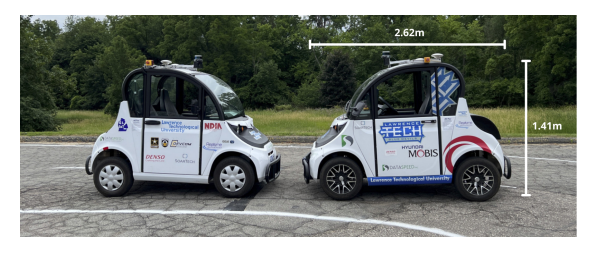
Anna Vadella (2025) spent the summer of 2024 at an NSF REU site (National Science Foundation Research Experiences for Undergraduates) at Lawrence Technological University (LTU), where she worked on a team researching algorithms, code, and AI for self-driving cars. In particular, they examined V2X communication systems to improve navigation and safety. V2X is where the car communicates with other cars and sensors positioned in the area to share information about hazards and obstacles that might be obstructed or out of range. The project was led by advisors Dr. Chan-Jin (CJ) Chung of LTU and Dr. Josh Siegel of Michigan State University. A draft of their paper is available on arxiv.org. Anna is now a graduate student studying computer science at Michigan State University.