

Curriculum
Attend only the classes you register for—pick the right pace for you!
The DMS Bridge Program incorporates 36 credit hours already completed during supervised clinical practice experiences (SCPE) from your entry-level master’s degree program.
The program curriculum includes two phases. The first is the foundational coursework phase, made up of three seven-week courses: Issues in Clinical Practice, Biostatistics, and Research Design. The second is a semester-long Capstone Project.
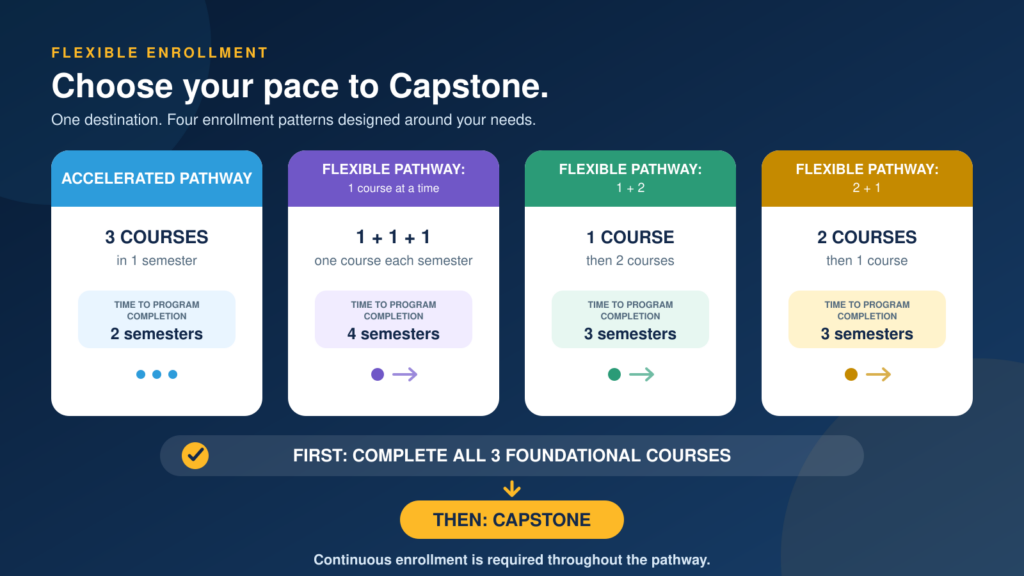
Students are able to choose the enrollment pace that fits their schedule. The program’s Accelerated Pathway completes all three foundational courses in a single term. Our Flexible Pathways spread the same three courses across two or three terms, one course at a time or in combination of one or two courses per term. At the conclusion of the program’s three foundational courses, both pathways lead to the semester-long Capstone Project.
Each foundational course includes one required synchronous session per week, along with weekly asynchronous coursework. Students must be available for both synchronous and asynchronous activities during any term in which they are enrolled in a course. The synchronous sessions are scheduled with the goal of greatest availability for a variety of schedules. Regardless of pathway, continuous enrollment is required; students must complete at least one foundational course each term until all three are finished.
After completing all three foundational courses, students move to a semester-long capstone project where students hone the skills of a data-driven leader by developing a highly personalized research project focused on an area of interest to the student, whether that means deepening expertise in their medical discipline, exploring a topic they’re passionate about such as PA education, or working toward a solution for a problem they’ve encountered in practice. The Capstone Project is firmly grounded in biostatistics and research design. It is anticipated that the typical student will complete their Capstone Project in one semester. If students do not complete the Capstone Project by the end of the term, they must enroll in a Capstone Continuation Course to maintain active enrollment in the program. Students must complete the Capstone within one year of starting the project unless they obtain permission from the DMS Bridge Program Director. The previously earned SCPE are combined with the 14-credit-hour online, 700-level Bridge courses.
| Didactic Courses | Credit Hours |
| DMS-BR778, Issues in Clinical Practice | 3 credit hours |
| DMS-BR780, Biostatistics | 3 credit hours |
| DMS-BR782, Research Design | 3 credit hours |
| Capstone | |
| DMS-BR784, Capstone Project | 5 credit hours |
This module extends students’ understanding of leadership and the impact of quality and patient safety on patient care. Topics will include the impact of preventable, adverse medical events on patients and medical professionals; prepares students to identify and participate in corrective strategies that improve quality and safety throughout their practice; and develops and nurtures a culture of quality and safety that enhances patient satisfaction and quality of care outcomes. Topics within leadership will include fundamentals of leadership, leadership and professionalism self-assessment, and leadership philosophy. Learners will model professionalism skills, best leadership practices and behaviors, and handling conflict. Learners will apply this to their personal and professional life through a series of practical exercises. Prerequisites: Completion of entry-level PA program, NCCPA certification, and admission to the Bridge Program. (G)(3) Summer, Spring, Fall
This course is designed to prepare the student to apply concepts of introductory statistical analysis to health-related investigations. Skills developed in this course emphasize a systematic and scientific approach to problem solving and a process for interpreting biomedical literature. The course provides the student with instruction in descriptive and inferential statistics, properly selecting the most appropriate statistical test for a given research question and data set, conducting hypothesis testing, and constructing confidence intervals. Statistical software is used to analyze datasets that demonstrate each of the most commonly encountered statistical tests. This course will primarily focus on conducting and interpreting the results of the most commonly employed statistical methods in the most commonly used designs in health research. Prerequisites: Completion of entry-level PA program, NCCPA certification, and admission to the Bridge Program. (G)(3) Summer, Spring, Fall
This course is designed to prepare the student to apply concepts of research design to health-related investigations. Skills developed in this course emphasize a process for interpreting biomedical literature. The course will primarily focus on designs and analysis and provide an overview of the various steps of the clinical research process such as problem formulation, hypothesis generation, study design, measurement, data collection, and analysis. Prerequisites: Completion of entry-level PA program, NCCPA certification, and admission to the Bridge Program. (G)(3) Summer, Spring, Fall
The course will primarily focus on clinical quality improvement design and analysis. The class will provide an overview of the various steps of the clinical research process such as problem formulation, hypothesis generation, study design, measurement, data collection, and analysis. The course will be dedicated to applying research design and biostatistical analysis concepts. In this independent study course, the student will complete a research/ clinical project and present the results of the research or the project. Prerequisite: Completion of DMS-BR778, DMS-BR780, and DMS-BR782 (G)(5) Fall, Summer, Spring
For any additional semester after the initial Capstone Project, the student will register for a Capstone Continuation Course with a continuing service charge to maintain the students’ enrollment. At the end of each semester, students who do not finish but demonstrate progress on their Capstone will earn a DEF (deferred) grade. A student’s progress through capstone continuation may increase their total number of degree credits beyond the required credits. Prerequisite: DMS-BR784 (P/DEF/F) (G)(3) Fall, Spring, Summer
Take the next step
Ready to learn how Butler’s DMS Bridge program can help you jumpstart your career? Join us for an upcoming online information session, schedule a meeting with our admission coordinator, or sign up to receive information about application reminders and more.
Contact Us
Phone
317-940-9322
